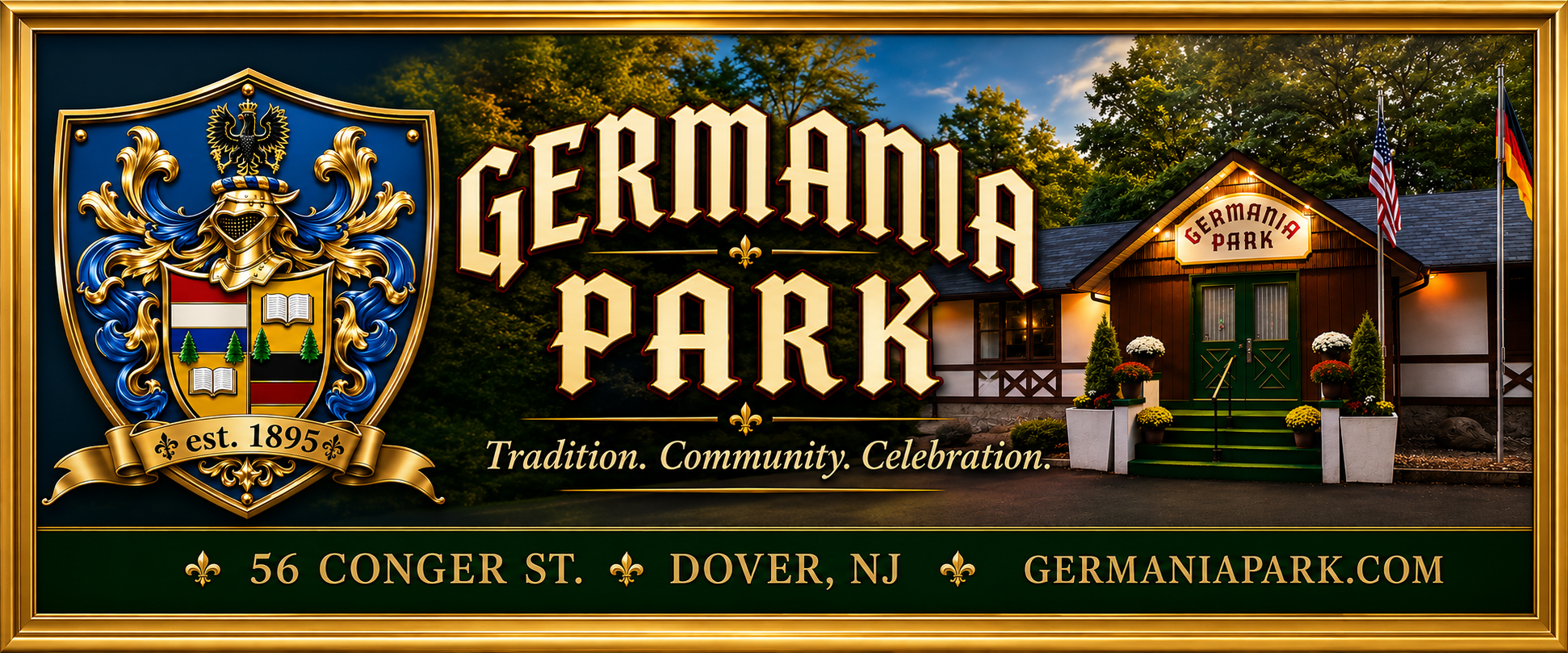
The History of Germania Park
The history of Germania Park is closely intertwined with the story of German immigration to northern New Jersey. During the second half of the nineteenth century and into the early twentieth century, thousands of German immigrants arrived in the United States seeking new opportunities. They brought with them not only valuable trades and technical skills but also a rich cultural heritage rooted in education, music, fellowship, and community.
Many of these immigrants came from the Erzgebirge (Ore Mountains) region of Saxony (Sachsen), Germany, an area renowned for its textile and knitting industries. As the silk and knitting mills of Dover, New Jersey, rapidly expanded, there was an increasing demand for experienced textile workers. The skilled German knitters answered that call, becoming instrumental in the growth of the local economy and helping establish Dover as an important manufacturing center.
Like German communities throughout America, these immigrants sought to preserve their language, traditions, and customs. They founded organizations such as Turnvereins (gymnastic societies), Gesangvereins (singing societies), and German language schools to strengthen community bonds while passing their heritage on to future generations.
The Beginning
In 1895, local German immigrants organized the Deutsche Vereinigung Dover (German Association of Dover). The organization served as both a cultural and social center, dedicated to preserving German traditions while helping immigrant families establish themselves in their new homeland.
Recognizing the importance of education, the association established a German language school in 1907 for children in the Dover area. The school flourished, and in 1916 the organization changed its name to the Deutscher Schulverein Dover (German School Society of Dover), reflecting its growing educational mission.
A significant milestone came in 1925 when the Schulverein purchased property in Rockaway Township from the Berry Farm Estate. This land would become the permanent home of Germania Park. In 1933, the organization was incorporated as the Deutscher Schul Verein, Inc.
The Gesang Verein
Music has always been an essential part of German culture. In 1897, members of the local community organized the Gesang Verein Dover, a German singing society dedicated to preserving the tradition of choral music. Since many of its members also belonged to the Schulverein, the singing society played an important role in supporting the German language school and strengthening the area’s German-American community.
Recognizing their shared mission, the two organizations merged in 1940 to form the Dover Schul- und Gesang Verein, Inc. Three years later, in 1943, the organization adopted the name Deutscher Schul- und Gesang Verein, Inc., a name that continues to reflect its commitment to both education and music.
Building Germania Park
During its early years, meetings and activities were held at Guenther’s Hall in Dover, a building constructed by textile manufacturer Paul Guenther, whose mills employed many members of the organization.
As membership continued to grow, the society developed its newly acquired property in Rockaway Township. The first building was a modest Waldhaus (Forest House), which today serves as the entrance foyer and coat room of Germania Park.
Expansion continued over the decades:
- 1929 – A classroom was added for the German language school, now serving as the club’s bar.
- 1935 – The ballroom was constructed, providing space for dances, concerts, and community celebrations.
- 1948 – Additional land was acquired for a soccer field used for soccer and Faustball, a traditional German sport.
- 1966 – The ballroom was enlarged, and modern water, sewer, and gas utilities were installed.
- 1970 – Air conditioning was added to both the ballroom and bar.
- 1976 – The popular open-air pavilion was constructed.
- Early 1980s – Outdoor food and beverage facilities were added, and fencing was installed around the main grounds to protect the property from increasing vandalism.
The soccer field, while originally home to athletic competitions among members, has also served the surrounding community. For many years, Germania Park has made the field available free of charge to the Rockaway Township Recreation Department for youth soccer programs. Today, it also provides additional parking during the club’s popular festivals.
Preserving German Heritage
Although the German language school eventually closed because of declining enrollment, Germania Park has remained steadfast in its mission of preserving German-American culture.
The club’s Mixed Chorus, continuing the proud tradition of the Gesang Verein, remains an active part of the organization, presenting concerts that celebrate German music and culture.
Throughout the year, Germania Park welcomes both members and the public to enjoy authentic German food, music, dancing, and fellowship. Traditional dinners, Biergartens, festivals, Oktoberfest celebrations, and cultural events continue to reflect the spirit of Gemütlichkeit—the uniquely German sense of warmth, hospitality, friendship, and community.
Beginning in 1975, Germania Park established a remarkable cultural exchange program by hosting musical groups from Germany and Austria. Over the decades, the club has welcomed 44 bands for extended summer and autumn visits, allowing audiences throughout the region to experience authentic German and Austrian music while strengthening ties with the organization’s European roots.
Germania Park Today
For more than 130 years, Germania Park has served as a gathering place where generations of families have celebrated their German heritage while welcoming friends and neighbors from every background.
What began in 1895 as a small association of German immigrants determined to preserve their language and traditions has grown into one of New Jersey’s most respected German-American cultural organizations. Germania Park remains dedicated to honoring the customs, music, food, language, and fellowship that its founders cherished, ensuring that this rich heritage continues to be shared with future generations.